

What Actually Goes Into Matching Luxury Car Paint in Los Angeles
Most people assume paint matching for luxury cars is straightforward. A shop looks up the color code, mixes the paint, and sprays it on. If only it were that simple. On a standard commuter car, a close match might be acceptable. On a Ferrari, Bentley, Porsche, or Lucid, close is not good enough. The repair has to disappear completely, whether the car is sitting under a parking structure or rolling down Sunset in direct sun.
Los Angeles makes this harder than almost any other city in the country. The sun here is relentless, and the coastal air adds its own variables. What goes into a proper luxury paint match is part science, part craft, and entirely dependent on the skill and equipment of the shop doing the work.
Why a Paint Code Is Only the Starting Point

Every vehicle leaves the factory with a paint code that identifies its color. Most people assume that code is the answer. In practice, it’s just the beginning. The factory standard for any given code comes with anywhere from three to seven approved shade variants. These exist because paint suppliers are allowed a small degree of variation in production, and because the same color can look different depending on geography, batch, and application conditions.
None of those variants account for what has happened to your specific car since it left the factory. UV exposure, washing, environmental fallout, and time all shift paint. A car that has been driving in Los Angeles for three years looks different from the same model that just rolled off the lot, even if the code is identical. Matching a repair to the car as it exists today, not as it was built, is where the real work begins.
How a Spectrophotometer Reads Your Car’s Paint
The tool that makes precision matching possible is a spectrophotometer. It scans the existing paint on your vehicle and measures how light bounces off it at multiple angles, capturing not just the color but the metallic flake density, the pearl effect, and the depth of the clear coat. The result is a digital profile of your paint as it currently exists.
This matters far more on luxury vehicles than on standard ones. A solid color on a mass-market car is relatively forgiving. A three-stage pearl on a Porsche or a deep metallic on a Lucid Air changes appearance dramatically depending on the angle and the light source. Without a spectrophotometer scan, a technician is working from a database formula that may not reflect your car’s current state. With it, the formula is calibrated to the actual surface, not the factory specification from years ago.
The Real Challenge With Metallic, Pearl and Tri-Coat Finishes
This is where general body shops most often fall short on luxury vehicles. Solid colors are relatively straightforward to match. Metallic, pearl, and tri-coat finishes are a different discipline entirely.
These finishes change appearance based on the angle you’re looking from and the light source you’re standing under. A repair that looks perfect in the booth can look visibly wrong in direct sunlight. Getting it right requires controlling multiple variables at once- the size and orientation of metallic flakes in the base coat, the thickness of each layer, the speed and pressure of application, and the timing between coats. A tri-coat pearl like those found on a Bentley or a high-spec Porsche can have eight to ten separate factors that all need to align. Miss any one of them and the mismatch shows. Experienced technicians who specialize in luxury and exotic paintwork understand these finishes at a level that general repair shops rarely develop.
Why LA’s Sun and Environment Complicate Everything
Los Angeles averages close to 285 sunny days a year. That level of UV exposure shifts paint faster here than in most American cities. Reds move toward orange. Blues take on a greener tone. Whites develop a slight warmth. A shop that matches to the original factory formula without accounting for how the existing paint has weathered in this specific climate will produce a repair that looks right on day one and wrong by the following summer.
Coastal areas add a further layer of complexity. Salt air in Malibu, The Palisades, Santa Monica, and the surrounding neighborhoods accelerates surface oxidation on aluminum panels and affects how clear coats hold over time. Owners in these areas often bring vehicles in for paintwork and cosmetic repairs that require matching paint that has been exposed to both intense UV and marine air simultaneously. A technician who understands the local environment will factor this into the formula before a single coat is applied.
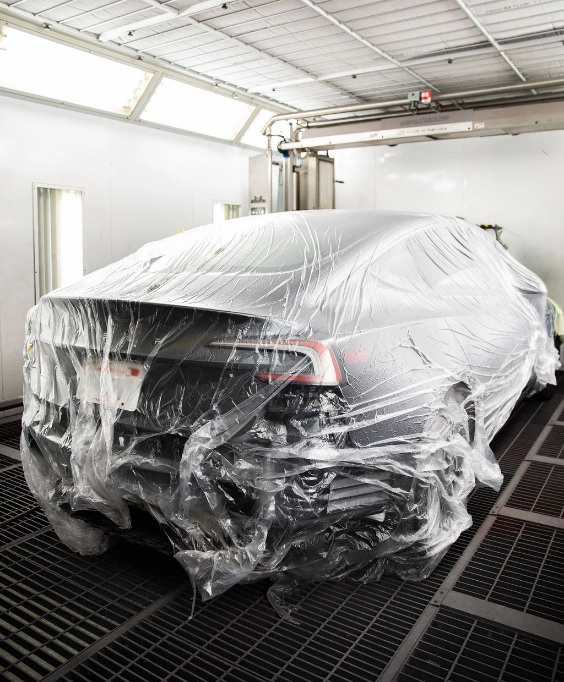
What a Climate-Controlled Paint Booth Actually Does
A proper paint booth is not just a clean room. It controls temperature, humidity, airflow, and lighting in ways that directly affect how paint behaves during and after application.
Temperature affects viscosity. If the paint is too cold or the booth too warm, the material applies differently, and the color can shift during curing. Humidity affects flash time, which is the window between coats when the solvent evaporates. If a second coat goes on before the first has properly flashed, the metallic flakes in the base coat don’t orient correctly and the color will look different at different angles. Airborne particles are another concern entirely. On a luxury finish, a single piece of dust in the clear coat is visible and unacceptable.
A climate-controlled booth eliminates these variables. On a three-stage pearl or a hand-finished exotic, this is not optional.
The Blending Step
Blending is the technique that makes a repair disappear. Rather than painting only the damaged panel and stopping at the edge, a skilled technician extends the new paint gradually into the adjacent panels, feathering it out so the eye perceives one continuous surface rather than a boundary between old and new.
On solid colors, blending is relatively manageable. On metallic and pearl finishes, it requires a much higher level of control. Spray pressure, gun speed, distance from the panel, and the timing between coats all affect how the flakes lay and how the color appears. Done correctly, the repair is invisible from any angle and in any light. Done poorly, the edge shows up the moment the car is in direct sun. For vehicles like a Tesla or a Lucid, where large flat panels and distinctive finishes are common, the blending step is where the quality of the shop becomes obvious.
How Paint Matching Connects to Resale Value
A mismatched panel on a luxury vehicle is not just a cosmetic issue. It signals previous damage, raises questions about the quality of the repair, and gives buyers reason to negotiate the price down or walk away entirely. On high-end vehicles, a visible paint discrepancy can reduce resale value by a meaningful amount.
Reputable shops document the entire paint process: the spectrophotometer scan data, the formula used, the variant selected, and the calibration applied. This kind of documentation tells the next owner that the repair was done properly and to a verifiable standard. It’s the same principle that applies to using OEM parts and following manufacturer repair procedures. The goal is not just a car that looks right today, but one that holds its value and its integrity over time. For owners of exotic and luxury vehicles in Los Angeles, that standard is not optional.
At Avio Coach Craft, paint matching for luxury and exotic vehicles is done using computerized color matching systems calibrated to the actual condition of your car, applied in a climate-controlled booth by technicians who specialize in high-end finishes. Whether it’s a single panel repair on a Bentley or a full refinish on a Tesla, the goal is the same- a result that is indistinguishable from the original. If you’re based in West LA or the surrounding areas and your vehicle’s finish needs attention, reach out for a free estimate.